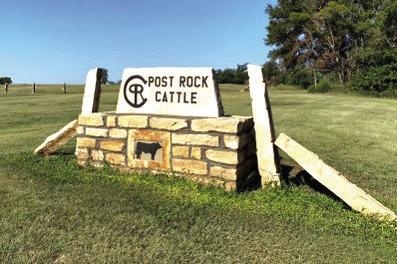
Two hundred bulls and female Gelbvieh (Gel-fee) cattle are heading to the Post Rock Cattle Company’s annual auction Feb. 25. Leland Clark, senior partner in Post Rock Cattle Company, said between the DNA testing, the Genomic Enhanced Expected Progeny Differences, and ultrasound technology they use on their cattle should give people confidence the breeding bulls they are purchasing are top quality. A list of prestigious awards presented in the past few years also validates the quality of the company’s resident sires. They won seven banners in the American Gelbvieh Foundation Scale and Rail contest and had two resident sires awarded the Grand Champion Pen of Carcass Value Steers, Probity in the Balancer division and 32F9 (Roy) in the purebred division. This brings to four the number of resident herd sires to have achieved that honor.
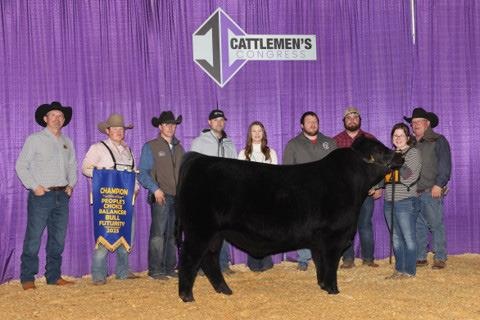
Additionally, at the Cattleman’s Congress Post Rock Prominent 139K8 was selected by the Balancer Futurity membership as the People’s Choice Balancer Futurity Champion Bull. They also had the purebred runner up in the Pure-bred Futurity with Post Rock Black Box 150K1.
Raising Gelbvieh
Clark’s family has raised Gelbvieh since the 1980s, perfecting their line through technology.
“My dad started this feedstock business with Hereford in 1952,” Clark said. “We switched to the Gelbvieh breed in 1983.”
He said the first time he had ever seen the breed, which originated in Bavaria, Germany in the 1800s, was when he was on a judging team at Colby Community College. It was the maternal traits and the performance of the animal that drew his interest in the breed.
“They have a high weaning rate,” Clark said. “If you have 100 cows in the herd with a high weaning rate you have more pounds to sell.”
With the exception of Jersey, the Gelbvieh has the earliest puberty of any beef breed. In normal conditions they can be joined at 13 months, to calve at 22 months. This gives the first-calf Gelbvieh heifer 15 months before it has to calve again as a 3-year-old. This extra 3 months seems to be advantageous to the young heifers, allowing them to continue to grow, whilst feeding their calves and being ready to return to service for their next pregnancy, according to several cattle websites.
To help buyers make informed decisions, Clark said every bull sold will have current Genomic Enhanced Expected Progeny Differences “Every bull has been DNA tested or known by birthright to be homozygous polled or homozygous
black,” he said.
Every bull is also DNA tested for sire verification and for any known potential genetic defect.
Post Rock Cattle Company has also started performing ultrasounds on every bull for ribeye area and intramuscular fat, or marbling.
“DNA testing and ultrasound collection are a major expense of both money and time commitment, but we feel they are necessary to positively impact (a buyer’s decision),” he said.
Family tradition Clark is a fifth-generation farmer and rancher in the tri-county area of Lincoln, Mitchell and Ottawa counties.
“My family came to the Barnard area in 1852,” he said. “We were the early settlers. Our family settled in the Milo area but Milo is now a ghost town.”
The family was originally from Scotland and had settled in Pennsylvania before his great-great-grandmother and her three sons embarked on a journey that took them to an unsettled land. It would still be nearly a decade before Kansas even became a state.
“I am really proud of the fact that I am the fifth generation to make our family living from the land and the livestock in the Barnard area,” he said.
In 1985, he and his late father, Bill, became partners in the Post Rock Cattle Company. The next generation has already stepped up to ensure the operation continues.
“My nephew Kyle (Cavalli) is very skilled at the cattle business and is taken the lead on the cattle side of the business and my sonin- law Will Johnson is taking up the farming side of the operation,” he said.
Clark said having a comprehensive transition plan in place is vital for any ranch or farm.
“It’s one of those things you have to have to be able to continue on to the next generation without the next generation having to buyout from the previous generation,” he said. “There’s tax implications if you are a farmer and rancher — if you don’t have a good transition plan you can get wacked on the back end. There are certainly easier ways to make a living but if that is what the younger generation wants to do, then certainly the senior generation needs to provide them the opportunity, get out of their way and let them charge. My kids — they are younger and smarter than I am.”