
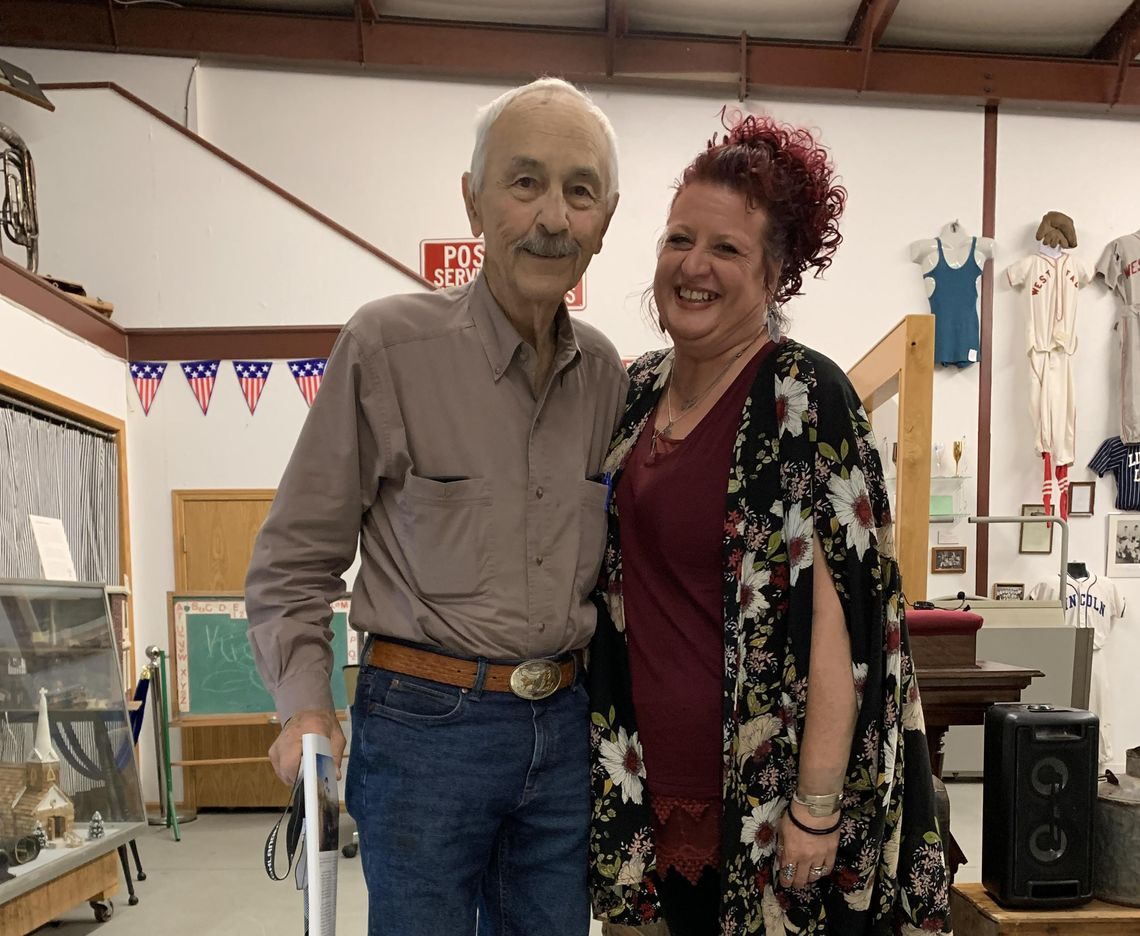
The Lincoln County Historical Society hosted folklorist Jim Hoy in a presentation of Kansas Legends and Folktales Saturday, June 22 at the Kyne House Museum. The program was made possible by a Kansas Humanities Council grant and the Kansas Humanities Speakers Bureau.
Hoy is professor emeritus of English at Emporia State University, where he also directed the Center for Great Plains Studies. The author of numerous books about cowboy life, including Flint Hills Cowboys: Tales from the Tallgrass Prairie and My Flint Hills: Observations and Reminiscences from America’s Last Tallgrass Prairie, he was raised on a small ranch near Cassoday in the Kansas Flint Hills. His deep connection to this region has influenced much of his work.
He taught literature and folklore at Emporia State for 45 years, during which time he served as the Chair of English for a decade. As a folklorist, Hoy is passionate about documenting and celebrating the lives of plains folk. His research has taken him across the American West, Australian bush and English countryside, seeking out stories, songs and the wisdom of old-timers willing to share their experiences.
In 2022 he received the Chester A. Reynolds Award from the National Cowboy and Western Heritage Museum for his unwavering commitment to Western ideals and values.
This was Hoy’s first trip to Lincoln in 50 years. When asked if it had changed much, he replied, “Not really,” which brought a chuckle from the audience. He was referring to the presence, use and preservation of Lincoln’s limestone business district, a testament to the city’s recent renovation efforts which have, in many cases, erased the erosion of the past.
Hoy explained the difference between legend, myth and folktales. A legend, he explained, is based on history and passed down to the generations. A myth typically is religious in nature. A folktale, on the other hand, is fiction.
As an example, German Mennonites, known to be pacifists, had been lured to Russia in the late 1700s with promises of military exemption. When Russian policy grew hostile in the 1870s, large numbers of this ethnic group left for more fertile lands, where they would not be required to take up arms.
Kansas was the destination of choice for many German-Russian immigrants. Western railroad companies hoped to develop communities along their lines to increase profits through the transport of products and grains. To populate these communities, they hired German recruiters to facilitate the immigration of skilled farmers from European countries with similar climates. They recruited not only among the German Mennonites, but also Roman Catholic Germans farming along Russia’s Volga River. German-Russian immigrants began arriving en masse on the central Great Plains during the 1870s; Mennonites settled in Marion County and Roman Catholics in Ellis County, Kansas.
These immigrants did not come emptyhanded. Family lore states that Mennonite families loaded kitchen crocks and traveling trunks with Turkey Red wheat seed before leaving Russia. As an example, one young child was said to have been sent to procure seed, her instructions being to fill two onegallon jugs with the best seed available. This required her to hand-pick each seed to fill to fill the containers. That is the legend. Hoy believes this symbolizes being a Kansan, citing the tenacity, work ethics and ingenuity of early pioneers.
Arriving in Kansas in 1874, they planted their first crop in the rich farmlands around Goessel. Although corn was the primary grain grown in Kansas at the time, Turkey Red wheat proved well-suited to the Great Plains. The wheat berry contained more protein (producing the best flour), demonstrated more resistance to disease, and survived the harsh winter conditions following fall planting.
In truth, Hoy said, a wealthy businessperson from Newton imported copious quantities of seed, which was planted, harvested and new seed dispensed throughout the state. Today, Kansas is one of the world’s top wheat producing regions, largely due to the legacy of winter wheat varieties like Turkey Red.
Some experts have argued the Turkey Red story is only a myth (fiction). They claim it is highly unlikely that immigrants transported enough wheat to plant a significant first crop. In addition, Turkey Red was not the typical wheat variety grown by Mennonites in Russia, casting further doubt on the legend.
Though it is difficult to determine who first introduced Turkey Red to Kansas, it is undeniable that German Mennonite communities like Goessel embraced the plant. Today, a vast number of modern wheat varieties grown in Kansas can be genetically traced to Turkey Red. The state is one of the world’s top wheat-producing regions today largely due to the legacy of winter wheat varieties like Turkey Red.
Hoy explored other fascinating tales with the group such as the Nemaha Mountains in eastern Kansas. Made of granite, these mountains are largely below ground. From the base to the remaining peaks, they would stand 3,300 feet high in Nemaha County. If there were travelers in eastern Kansas during the exposure of these mountains, they would appear much as the present-day Front Range and Rocky Mountain peneplain do today to travelers to Colorado Springs and Denver. Legend has it that Kansans are more reserved people than those in Colorado, so the mountains are buried so as not to brag.
Before concluding the program, the audience told Hoy the local legend of the suitcase tombstone, and as he bid goodbye to his hosts, he set off to find it himself.
Look for more LCHS Saturday programs to follow.