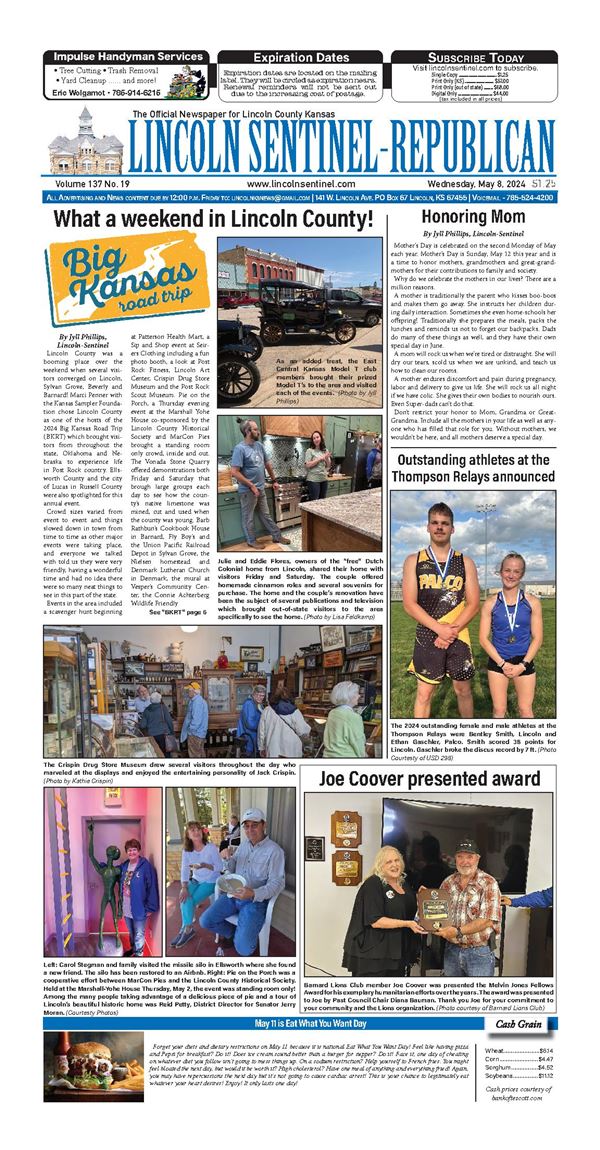
Massive change in the way the newspaper business operates nationwide has impacted every facet of the publishing world, including the production of the Lincoln Sentinel-Republican.
Several months ago, the printing plant in Clay Center — where all the JLS publications were printed —was purchased by another company that decided to close the operation and move all printing to Manhattan, according to JLS Chief Executive Officer Dale Worley.
Over the past 20 years, publications everywhere have closed or been sold, including large newspapers that used to offer printing services to smaller publications. With only a handful of newspaper printing plants still operating in Kansas and the region, it’s a challenge to find a printer. And when a newspaper does find one, they have little control over their print schedules.
Fortunately, the JLS newspapers will still be delivered on their previous publication days; however, delivery may be a little later in the day due to the new press time and the extra distance involved in transporting the papers.
No leeway for late items Worley said the deadlines for the newspapers will not change; however, items must be submitted by the deadline.
“Because we were involved in the printing operation in Clay Center, we could get late submissions in much easier, but now we have much less leeway,” Worley explained.
Press operations are shutting down because costs have increased so much in the past several years that they are very marginal — which means fewer and fewer printing options are available, Worley said.
The closing of the Clay Center plant—one of hundreds nationwide that have closed in recent years — underscores a sad reality for print journalism.
“The newspaper industry is in a decline,” Worley explained. “If our communities are going to maintain newspapers, they must have local support. We don’t have the revenue post COVID with the decline in advertising. Add to it, the pressure that rising inflation has brought on all small town businesses, making it difficult to have full-time staffs anywhere.
“Considering we only have a very small number of people involved in all our newspapers, they are very dedicated, they work extremely hard with limited resources and they try to put out the best product they can in less than ideal economic circumstances,” Worley added.
Skyrocketing increases in newsprint, ink, utilities, gas, mailing and delivery costs and other factors are forcing many newspaper publishers — big and small — out of business.
“These are just some of the changes that are happening in the newspaper industry making it difficult for us to publish newspapers traditionally,” Worley added.
The rise of social media also has had a detrimental effect on the newspaper business.
For instance, instead of buying a classified ad to place a yard sale most people today post that information on social media. Likewise, most businesses no longer purchase advertising like they did in the past.
“Social media has completely changed everything. It has taken a huge amount of the revenue we used to have and directed those dollars to big tech companies,” Worley explained. “That income was how we were able to hire local editors and reporters.”
Does print have a future?
Despite the challenges, Worley believes newspapers can survive if they become digital-based publications with perhaps a limited print product.
“Right now, putting out a print newspaper is cost prohibitive. Even though your inputs have gone up, you can’t pass your costs on to advertisers or subscribers because people who are struggling with high costs everywhere can only do so much,” Worley said.
“We are very fortunate to have local contributors who submit photos and local news content to help provide coverage to our readers,” Worley continued. “These talented ‘citizen journalists’ go the extra mile to promote and enhance their communities.”
With all the changes, Worley noted it’s a critical time for local media and it’s difficult to know what the future holds. “If newspapers disappear there will be no record of our communities, no gathering place of ideas, no chronicling of activities. One hundred years down the road there will be no printed source to see what happened in our communities.
“I’m trying to ensure the newspapers that I have left survive beyond me,” Worley said. “We’re working to put things in place to make that possible so communities do not lose the institution of the newspaper itself. But we can’t do it by ourselves. We have to have community support or it won’t work.