In my August 23, 2023, column I proposed that the Lincoln City Council add three elements when considering demolition of an old structure:
• The structure’s history, including who built it and the owner’s contributions to the history and culture of Lincoln
• The structure’s unique architectural features that provide character and differentiate the it and Lincoln from other communities
• Whether other structures of similar age and blighted condition have been restored and returned to the community I realized I made a mistake in that last column. I should have said that I want the City Council and the County Commission to take history into account when they consider demolishing old structures.
The house I’m writing about today is owned by the County which acquired it in October, 2020, after it did not sell at a tax sale.
711 N. 3rd. Street, Lincoln, Kansas The size of the house is impressive. A large eat-in kitchen; an enclosed sun porch on the south side of the first floor; a big dining room with a built-in china cabinet and glass doors; a large living room; and a first floor bedroom. A large bathroom with a bathtub is located on the first floor off the kitchen.
The stairway to the second floor is a winder staircase - a staircase that has no landing but has both straight and angled steps. See a picture from Wikipedia.
walls with no handrails, making it quite treacherous.
The second floor has three large bedrooms and a central hall. If I remember correctly there’s a central closet at one end of the hall, but no upstairs bathroom.
All of the unique architectural features that were once part of the house were stripped out long ago. Only a shell remains. I’m not arguing that this house be saved because I believe it’s too late.
However had the research regarding the history of the house been done years ago, the former owners and community members might have realized they had an historic icon in their midst and they might have been able to save the house to use it for promotional and tourist activities.
That’s because the original owner of the land, according to the Register of Deeds, was Nathaniel Province (N. P.) Simpson, one of Lincoln’s “characters”.
N. P. was born in March, 1824, in Pennsylvania. He married and later one child, Henry Clay Simpson, was born on June 30, 1852. Some time after the birth of the baby, N. P. and his wife separated and N.P. began his travels across the country in search of his fortune.
Between the time he left Pennsylvania and the beginning of the Civil War, N. P. struck gold in Nevada, Colorado, or someplace else. During the war N. P. converted his gold into greenbacks, trading one measure of gold for two greenbacks - paper money issued by the United States government during the Civil War.
The Sandusky, Ohio, Register, among others, reported on November 11, 1923, that “sometime in the early 80s . . . Nathaniel P. Simpson, then a poverty-stricken Indian trader who was widely known throughout the West, appeared in Albuquerque, N. M. with a threeweek-old baby girl wrapped in an Indian blanket.” N. P. named the baby Sypora, “which in the Indian tongue means’ ‘Sap of the Quaking Aspen.’” He determined that he could not care for the baby properly and left her with an Albuquerque woman who raised her.
In 1885 N.P. moved to Kansas City, Missouri, and made that community his permanent home.
But his travels continued and in early April, 1886, he purchased the property in Lincoln that we know as 711 N. 3rd.
A May 14, 1895, news story in the Lincoln Beacon reported that N. P. was shipping a “large number of range cattle into Lincoln County to feed.”
According to the 1900 national census, N. P.’s son, Henry Clay, his wife and children had moved to Lincoln. N. P. made periodic visits to Lincoln to visit his son.
N. P. died on Christmas Day, 1911, on a public street in K. C., accompanied by Henry Clay.
They had attended a Christmas dinner and were waiting for a street car when N. P. collapsed. He died within a few hours, and that’s when his story took a soap opera-like turn.
When N. P. died his estate was reported as $327,000 (worth $10.5M today) up to $825,000 (worth $26.5M today).
Heirs began popping up like dandelions in the spring, all claiming that N. P. was their father.
The Lincoln Republican, on January 25, 1912, reported “. . . it was no great surprise when it was learned that attempts were being made to find lost or missing ‘heirs’ to share in the estate.
Several stories have been started, presumably by snitching attorneys . . .” The battle over the estate waged for over a year but was finally settled in 1913 with Henry Clay declared the one true heir.
Then on October 5, 1923, The East Liverpool, Ohio, Evening Review reported that Sypora Simpson Snyder filed a “suit three days before the statute of limitations” ran out, “10 years after the adjudication of the estate.” She ultimately lost, not because her information was false but because the court ruled that her information was irrelevant.
Thirty-one Simpson descendants of N. P. - and their spouses - are buried in Lincoln County; eight at the Lincoln Cemetery; five at Milo; three at Sylvan Grove; and 15 at Milo.
N. P. Simpson was a larger-thanlife figure, described as a “very eccentric character”, “strange”, and “an aged recluse.” He was also extraordinarily wealthy for his time.
The Simpson family was a big contributor to life in Lincoln County. But they have been forgotten.
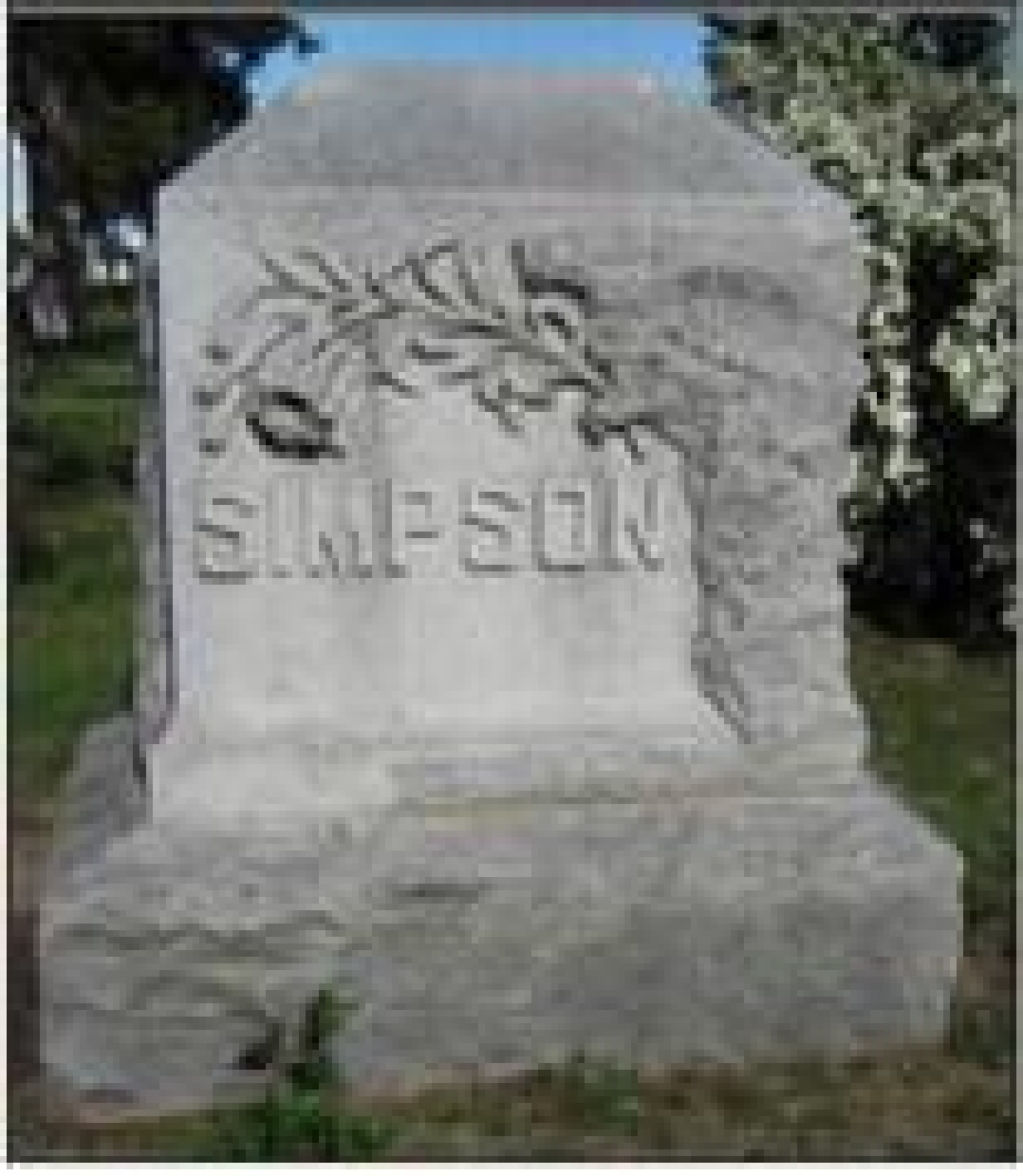
The only visible signs that any of the family passed this way are the headstones with the biggest and most impressive one being this: